
Trials & Research
Southern Humates is committed to demonstrating the effectiveness of humate as a powerful soil amendment. Over many years, we have proudly invested time, funding and effort into research and field trials to better understand and demonstrate the benefits humate can bring to your soil and farming system.
Humate alongside urea in Southland pasture.
A four-year trial at Mataura compared urea alone with urea and Southern Humates on ryegrass and white clover pasture.
Across the trial, adding humate increased pasture yield by an average of 9.8% beyond urea alone. The researchers also reported changes in soil microbial diversity and function, and greater nitrogen retention. They suggested this could reduce nitrogen loss, while recognising that outcomes depend on the product and conditions.
Increase in dry matter production with a reduction in urea of 20%.
Location: Mataura, Southland
Duration: Four growing seasons
System: Ryegrass and white clover pasture
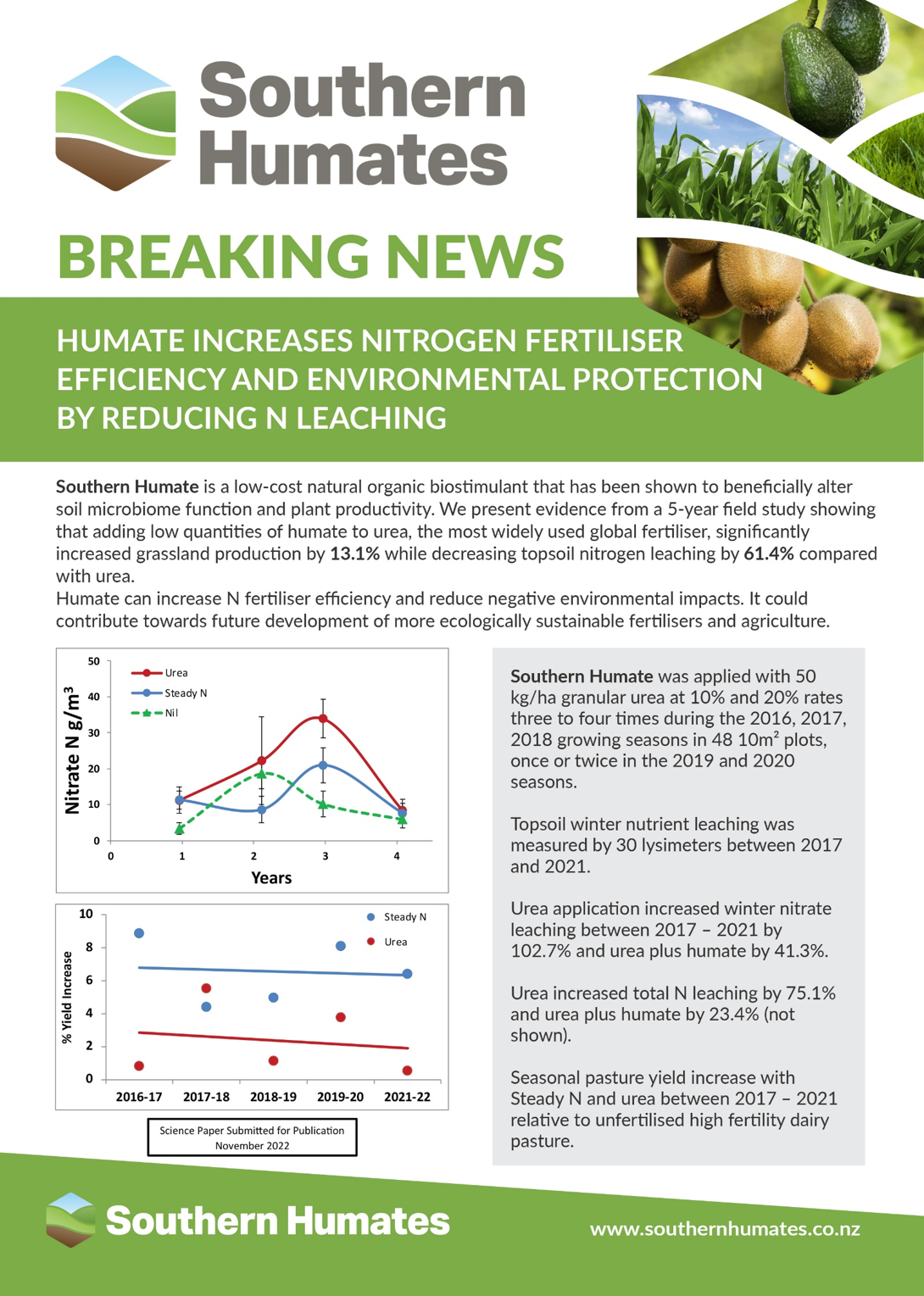
Pasture growth and nitrogen leaching.
A five-year field trial reported that adding Southern Humate to urea increased grassland production by 13.1% compared with urea alone, while reducing measured topsoil nitrogen leaching.
The trial applied 50 kg/ha granular urea with 10% and 20% humate in 48 plots, with winter nutrient leaching measured using lysimeters. The results showed winter nitrate leaching increases of 102.7% for urea and 41.3% for urea plus humate relative to the unfertilised treatment.
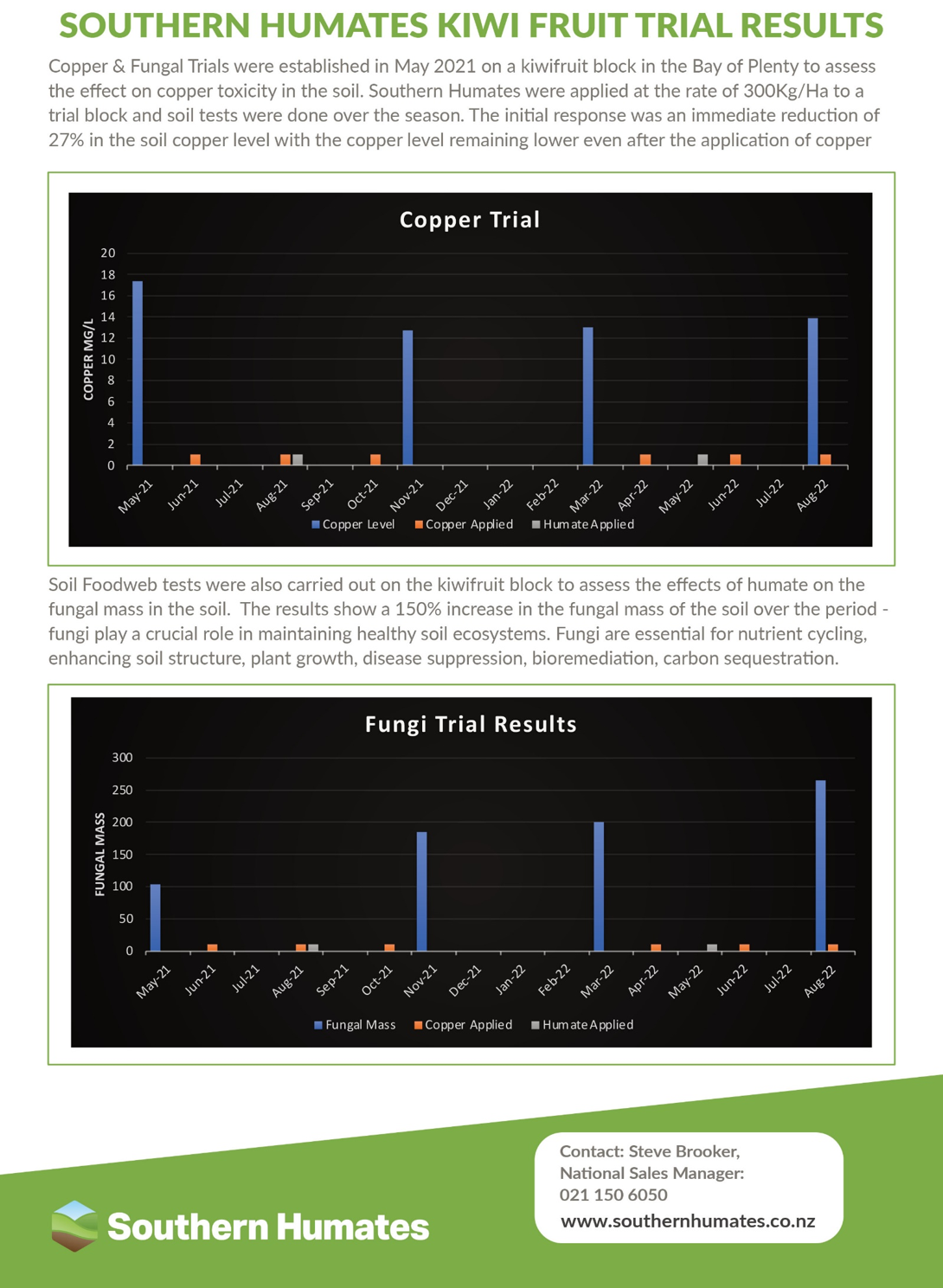
Kiwifruit soil copper and fungal mass.
A kiwifruit block in the Bay of Plenty received Southern Humates at 300 kg/ha. The results show an initial 27% reduction in measured soil copper and a 150% increase in fungal mass over the monitoring period.
The trial began in May 2021 and tracked soil copper and Soil Food Web results during subsequent copper applications.
Soil microbiology after six weeks.
A pasture paddock was divided into four quarters. Two received Southern Humates at 66 kg/ha and two received none. After six weeks, multiple soil samples from each quarter were sent to the Soil Foodweb laboratory for analysis.
| Measurement | Without humate | With humate |
|---|---|---|
| Dry weight | 0.680 | 0.660 |
| Active bacteria | 25.1 | 29.2 |
| Total bacteria | 416 | 386 |
| Active fungi | 0.25 | 7.5 |
| Total fungi | 151 | 239 |
| Active fungi : active bacteria | 0.01 | 0.26 |
The treated samples showed higher active bacteria, active fungi and total fungi, while total bacteria were lower. The reported ratio of active fungi to active bacteria was also higher in treated pasture.
Start with your own soil.
Use the humate advisor to explore your crop, soil test and Soil Food Web figures, then talk through the practical application with our team.